Local SEO in Naples: How to Get Your Business Found on Google in 2026
Table of Contents
- What local SEO means
- Why local SEO matters in Naples
- How Google selects local results
- Optimising your Google Business Profile
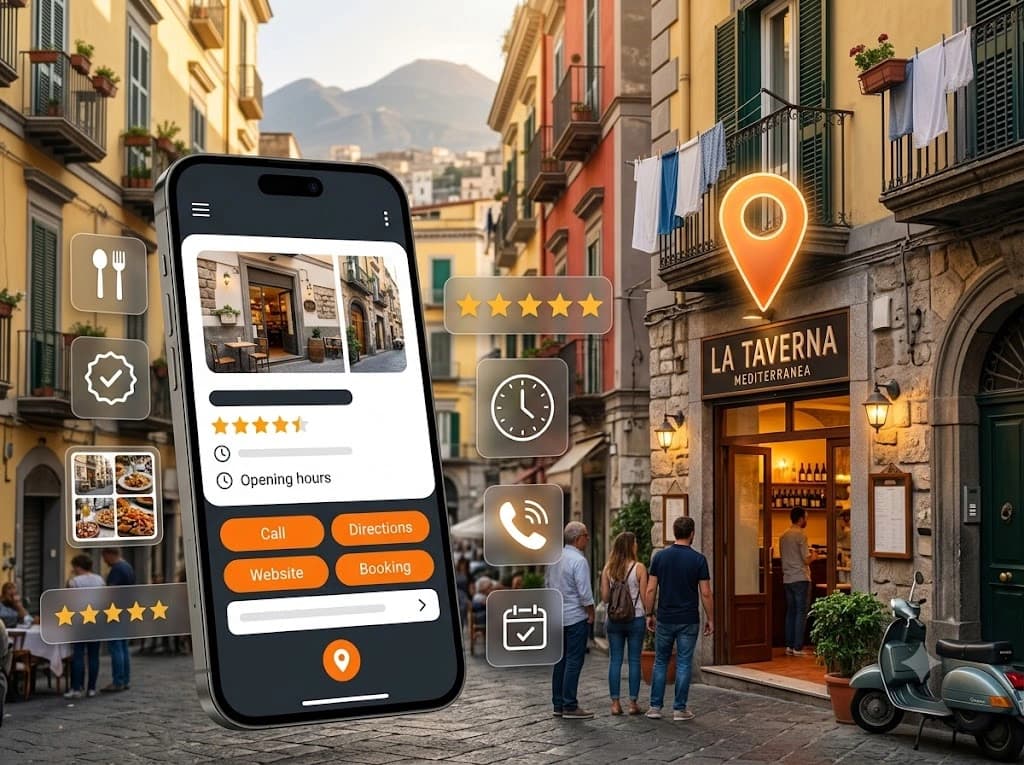
A restaurant near the Historic Centre may serve excellent food, earn enthusiastic recommendations from regular customers and offer a better experience than several nearby competitors. Yet when a visitor searches for “traditional restaurant near me,” the business may be almost invisible.
The same problem affects B&Bs in Chiaia, beauty salons in Vomero, medical practices near Mergellina and trades businesses serving Fuorigrotta. The quality of the service is not necessarily the problem. The problem is that Google has not received enough clear, consistent and trustworthy information to recognise the business as a strong match for the search.
That is what local SEO addresses.
Effective local SEO in Naples helps a business appear when people are actively searching for a nearby product, service or place to visit. The goal is not simply to generate more website traffic. It is to generate commercially useful actions: phone calls, table reservations, appointment requests, shop visits, booking enquiries and qualified leads.
How Google selects local results
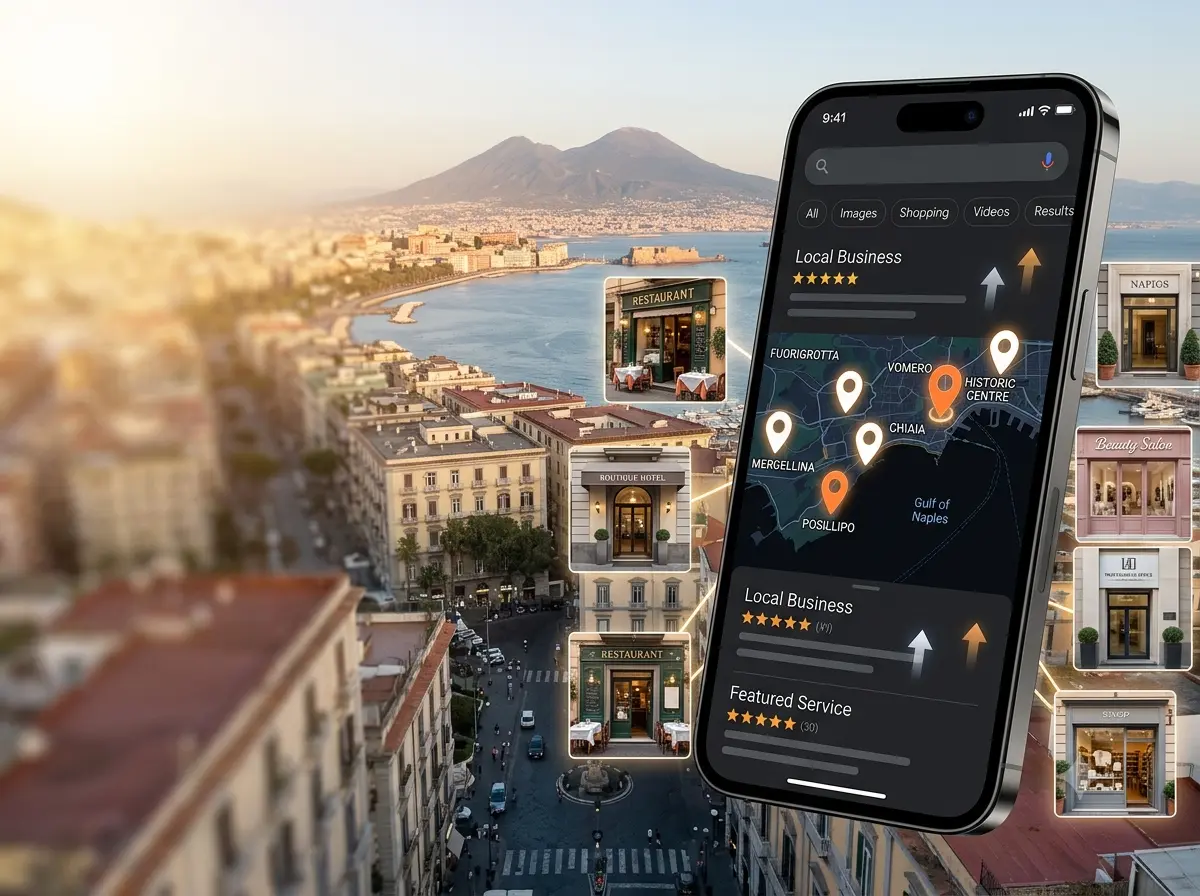
Google states that local results are mainly based on three factors: relevance, distance and prominence. Businesses cannot request or pay Google for a better organic local ranking.
Relevance
Relevance concerns how closely a business matches what the customer is searching for.
A correctly categorised seafood restaurant with a complete profile, an accurate menu, relevant website content and clear location information gives Google more context than a profile containing only a name, address and telephone number.
Distance
Distance concerns how far a potential result is from the location used in the search. When the customer does not include a location, Google may estimate location using the information available about that person.
This is why rankings can differ from one street or neighbourhood to another. A business may be highly visible to customers nearby but less visible to someone searching from the other side of the city.
You cannot optimise your way out of genuine physical distance. Creating misleading addresses or pretending to have offices in areas where you do not operate risks violating Google’s business representation guidelines.
Prominence
Prominence broadly reflects how well known and established a business appears. Google says it uses information from across the web, including links, articles and directories. Review count and review scores can also contribute to local ranking, while normal website SEO practices remain relevant.
That does not mean the business with the most reviews always ranks first. Google combines multiple signals, and results can vary according to the search, location, competition and available business information.
Optimising your Google Business Profile
A Google Business Profile is one of the most visible parts of a local SEO strategy. It allows an eligible business to manage how it appears on Google Search and Maps without paying a listing fee.
It should be accurate before it is promotional.
Select the right categories
Choose the primary category that most accurately describes the main business activity. Secondary categories can represent other genuine services, but they should not be used to list every service or keyword you would like to rank for.
For example, a property that primarily operates as a bed and breakfast should not select unrelated hospitality categories simply because they appear popular. Google advises businesses to use categories that describe what the business is, rather than using categories as keywords or descriptions of features.
Keep contact details accurate
Check your business name, address, telephone number, website and service area. Use the business’s real-world name rather than adding promotional phrases such as “best hotel Naples” to the profile name.
Google may also update profile information using user reports, licensed content and other sources, so profile owners should review suggested or automatic changes regularly.
Update hours and special hours
Opening hours should reflect when customers can actually visit or receive service. Add special hours for public holidays, seasonal schedules and temporary changes.
Incorrect hours create more than an SEO problem. They can lead to wasted journeys, negative reviews and lost trust. Google allows verified businesses to update their regular business information, including opening hours, contact details and photos.
Add services and products
List your genuine services in clear customer language. A beauty salon might include bridal makeup, hair colouring and facial treatments. A trades company might list emergency plumbing, boiler repairs or electrical inspections.
Restaurants, retailers and service businesses may have different profile features available. Use the fields Google provides, but avoid repeating the same keyword unnaturally in every description.
Write a useful business description
Explain what the business does, where it operates and what makes the offer relevant. Include factual details rather than slogans.
A strong description for a B&B could mention its location, accommodation style, nearby transport options and the types of guests it commonly serves. It should not read like a block of search terms.
Upload authentic photos and videos
Use current images of the exterior, interior, staff, services, rooms, products or dishes. Exterior photographs are particularly useful because they help arriving customers recognise the location. Google specifically encourages verified businesses to add photos and videos showing the premises, products and services.
Authenticity matters more than producing a large library of heavily edited stock-style images.
Publish relevant updates
Google Business Profile posts can include updates, photographs, videos and action buttons.
Useful posts might announce a seasonal menu, revised check-in hours, a new treatment, an event or a limited service change. Posts should support the customer’s decision rather than being published merely to keep the profile active.
Google does not publicly confirm that posting at a particular frequency directly improves ranking. Treat posts as a communication and conversion feature, not a guaranteed ranking technique.
Monitor questions and answers
Where customer questions appear on your profile, answer them clearly and promptly. Typical questions may concern parking, accessibility, vegetarian options, foreign-language support, check-in arrangements or service coverage.
Review this area periodically because answers may be contributed publicly and may not always come from the business itself.
Add reservation, appointment and contact links
Where the profile category supports them, connect customers directly to the correct reservation, booking, ordering or appointment page. Google allows eligible businesses to add and manage transaction links from their profiles.
Send users to the most relevant page rather than the website homepage. Someone ready to reserve a table should not have to search through the entire site to find the booking form.
Local keyword research
Local keyword research begins with customer language, not with a spreadsheet containing hundreds of variations.
Think about the service, the location and the customer’s immediate need.
A hotel might research terms such as:
- boutique hotel Naples centre
- hotel near Naples port
- accommodation near Napoli Centrale
- family hotel Chiaia
A professional practice might target:
- English-speaking accountant Naples
- physiotherapist Vomero
- dental clinic near Mergellina
- business lawyer Naples
A trades company might focus on:
- emergency plumber Naples
- electrician Fuorigrotta
- air-conditioning repair Posillipo
- commercial cleaning Naples
Searches using “near me” do not always require the phrase “near me” to appear repeatedly on your website. Google interprets the customer’s location and the local relevance of available businesses. Your task is to describe your services and actual operating areas accurately.
A specialist may also use Google Search Console, Google Ads Keyword Planner and Business Profile performance data to identify queries and customer actions. These tools should inform professional judgement rather than dictate awkward wording.
On-page local SEO
Your website should confirm and expand on the information in your Business Profile.
Each important page needs a concise, descriptive title. Google recommends unique page titles that accurately describe the content and avoids vague titles such as “Home” or unnecessarily long wording.
A useful service-page title might be:
Airport Transfers in Naples | Company Name
Headings should help readers scan the page. They should explain the subject rather than repeat the same keyword in several slightly different forms.
Create separate service pages when the services have meaningfully different customer needs. A legal practice, for example, may need distinct pages for company formation, property transactions and immigration support.
Location pages can be helpful when a business genuinely serves several areas and can provide useful information for each one. They become a liability when dozens of pages use almost identical text with only the place name changed.
Internal links should connect related services, guides and contact pages. Google recommends a logical site structure and concise, relevant internal link text.
Make your contact information easy to find, and consider valid LocalBusiness structured data to help Google interpret details such as the business type, address and opening hours. Structured data can improve Google’s understanding, but it does not guarantee a special result or higher ranking.
Most importantly, match the page to search intent. Someone searching for “emergency locksmith Naples” needs availability, coverage, contact options and reassurance. A long history of locksmithing is secondary at that moment.
Reviews and reputation
Genuine reviews can influence trust and local prominence. Ask customers for feedback after a real transaction, stay neutral about the rating and make the process convenient.
Good moments to request a review include after a completed appointment, successful checkout, delivered project or resolved support issue. A direct review link can be included in a follow-up email or message.
Do not buy reviews, exchange discounts for positive ratings or ask staff and associates to create false experiences. Google’s policies prohibit paid reviews, reviews not based on genuine experiences and coordinated attempts to manipulate ratings.
Respond to positive reviews with brief, specific thanks. For negative feedback, remain calm, acknowledge the concern and invite the customer to continue the discussion privately where appropriate. Avoid sharing confidential details, particularly for medical, legal or professional services.
A professional response will not satisfy every reviewer, but it can show future customers how the business handles problems.
Local citations and contact consistency
A local citation is an online mention of a business’s identifying information, usually its name, address and telephone number.
Relevant citations may appear on established business directories, professional associations, tourism platforms, local chambers, hospitality websites and industry-specific portals.
The information should be consistent enough that customers and search engines can recognise the same organisation. Differences such as an old phone number, outdated address or former business name create confusion.
Consistency does not require every listing to use identical punctuation. The priority is that the underlying information is accurate.
Quality matters more than listing the business on hundreds of unrelated directories. Focus on platforms customers genuinely use and sources that are relevant to the industry or region.
Mobile performance and user experience
A local search often ends on a phone. The website must therefore make the next action obvious.
Telephone numbers should be clickable. Booking buttons should work. Forms should be short enough to complete on a mobile screen. Directions, prices, service areas and opening information should not be hidden behind complicated menus.
Speed also matters. Google describes Core Web Vitals as user-experience measurements, but it warns that achieving good scores does not guarantee top rankings. A strong overall page experience is broader than any single technical score.
From a commercial perspective, the standard is simple: can a potential customer understand the offer and act without frustration?
Compress oversized images, remove unnecessary scripts, test forms on real devices and inspect the site on slower mobile connections. A technically impressive website that makes booking difficult is not performing its main job.
Local content ideas for Naples businesses
Useful local content answers real pre-purchase questions. Depending on the business, possible topics include:
- A hotel guide to reaching the property from Napoli Centrale, the airport or the port.
- A restaurant’s explanation of seasonal local ingredients and how its menu changes.
- A B&B guide to choosing between the Historic Centre, Chiaia and Vomero.
- A tour operator’s practical guide to visiting Pompeii from Naples.
- A clinic’s guide to booking an appointment as an international visitor.
- A trades company’s checklist for maintaining holiday-rental properties before peak season.
- A retailer’s guide to finding its shop, including parking and public transport information.
- A wedding or events business guide to venues in Naples and nearby municipalities.
- A property service explaining common maintenance issues in older local buildings.
- A professional adviser’s guide to opening or operating a small business in the area.
These articles should contain experience, original observations and information the intended customer can use. Google recommends people-first content that offers genuine value rather than pages created mainly to attract search traffic.
FAQ
1. How long does local SEO take to produce results?
Initial improvements may become visible within several weeks or months, but there is no standard timeline. Competition, distance, website quality, reviews and the business’s starting position all affect progress.
Can I pay Google to improve my local organic ranking?
No. Google states that businesses cannot request or pay for better organic local rankings. Paid Google Ads are separate from organic Google Search and Maps visibility.
Do Google reviews help local SEO?
Google confirms that review count and review scores can contribute to local prominence. Reviews also influence customer trust, but they are only one part of local visibility.
Do I need a website if I have a Google Business Profile?
A website is strongly recommended. It provides detailed service information, supports organic search visibility, reinforces local relevance and gives customers a controlled place to enquire, book or purchase.
Should I create a page for every Naples neighbourhood?
Only when each page serves a genuine customer need and contains useful, distinct information. Creating duplicate pages with substituted place names can produce poor-quality content and a confusing website.
Conclusion
Local SEO is most valuable when it reduces the distance between a customer’s need and a business’s response.
A person searching for accommodation wants confidence before booking. A restaurant customer wants to know whether the venue is open and suitable. A property owner wants a trades company that serves the correct area. A patient wants trustworthy information and a simple appointment process.
Businesses that provide those answers clearly give themselves a better opportunity to appear, earn the click and convert attention into revenue.
Ranking is part of the process, but it is not the entire objective. The stronger outcome is a local search presence that consistently produces calls, reservations, visits and qualified enquiries.
References
- Search Engine Optimisation Services — link from discussions of website SEO, keyword research and organic visibility.
- Website Design and Development — link from the mobile performance and user-experience section.
- Content Strategy and Copywriting — link from the local content ideas section.
- Digital Marketing Services — link from the introduction or final perspective.
- Social Media Management — link where reputation, local communication or content promotion is discussed.
- Contact Apexon Solutions — link from the final consultation invitation.