How Much Does a Professional Website Cost in Naples in 2026?
Table of Contents
- Website cost in Naples: a direct pricing overview
- What determines the cost of a website?
- Realistic website examples for Naples businesses
- Freelancer, local agency or remote agency?
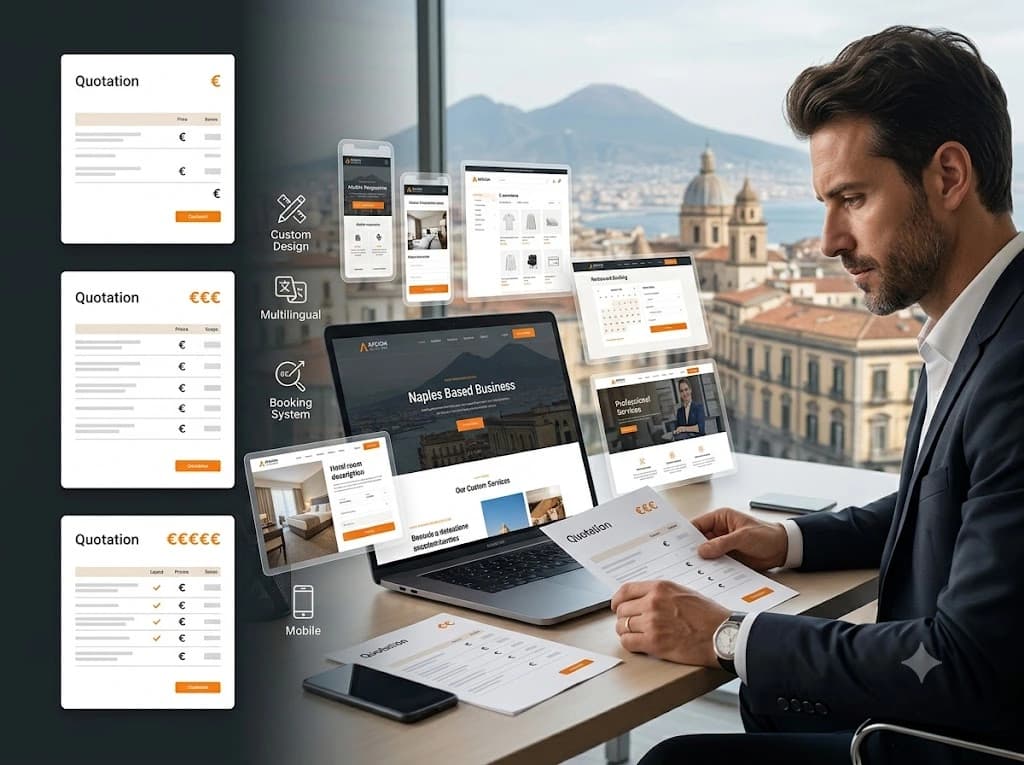
A restaurant owner in Naples asks three providers to quote for a “professional five-page website.”
The first quotation is €700. The second is €2,800. The third is almost €7,000.
From the owner’s perspective, all three appear to cover the same basic pages: Home, About, Menu, Gallery and Contact. Yet the difference may have little to do with the number of pages.
One quotation may use a standard template and expect the client to supply all text and photographs. Another may include research, custom design, English and Italian copywriting, search-engine setup, reservation integration, mobile testing, analytics and post-launch support. The most expensive proposal may include valuable work—or simply unnecessary features and a higher agency overhead.
That is why comparing website quotations by the final number alone is risky.
The website cost in Naples in 2026 can reasonably range from several hundred euros for a limited one-page project to tens of thousands of euros for an advanced e-commerce operation or custom web application. The useful question is not merely, “How much does a website cost?” It is, “What business problem must this website solve, and what work is included in the price?”
This guide provides practical price ranges, explains the assumptions behind them and shows how to assess a quotation without overpaying or choosing a project that is too limited to support the business.
Website cost in Naples: a direct pricing overview
The following estimates cover professional production rather than purely do-it-yourself subscriptions. They are planning ranges rather than fixed Naples market rates.
Unless a supplier states otherwise, assume prices are exclusive of VAT, recurring software subscriptions and third-party fees. Ask for written confirmation before accepting a quotation.
| Website type | Indicative build price | Typical scope | Suitable for | Common features | Complexity | Likely ongoing expenses |
|---|---|---|---|---|---|---|
| Basic one-page website | €600–€1,800 | One long page with 4–7 sections | New businesses, individual professionals, single-service campaigns | Introduction, services, contact form, map, call button | Low | Domain, hosting, maintenance |
| Small professional business website | €1,500–€4,000 | Approximately 5–10 pages | Salons, consultants, trades companies, clinics, local shops | Service pages, gallery, forms, basic SEO, analytics | Low to moderate | Hosting, updates, security, optional SEO |
| Custom corporate website | €4,000–€12,000+ | Approximately 10–40 pages with custom design | Established SMEs and multi-service companies | Custom layouts, content strategy, case studies, integrations, multilingual content | Moderate to high | Maintenance, content, software and marketing |
| Restaurant website | €1,800–€5,500 | Core pages, menu and reservation journey | Restaurants, cafés and hospitality venues | Menu, gallery, map, reservation link, multilingual content | Moderate | Hosting, menu updates, booking-system fees |
| Hotel or B&B website | €2,500–€8,000+ | Property, rooms, location and booking content | B&Bs, guesthouses, boutique hotels | Room pages, booking engine, multilingual content, galleries, policies | Moderate to high | Booking software, hosting, maintenance and updates |
| E-commerce website | €4,000–€15,000+ | Store setup with approximately 20–500 products | Retailers, producers and specialist brands | Catalogue, checkout, payment, shipping, tax settings, inventory | High | Platform plan, apps, payment fees, support and marketing |
| Appointment or booking website | €2,500–€8,000+ | Business site with scheduling or availability | Salons, clinics, consultants, tours and rentals | Calendar, availability, reminders, deposits, customer emails | Moderate to high | Booking software, payment fees and support |
| Custom web platform or application | €12,000–€80,000+ | Bespoke workflows, user accounts and integrations | Businesses with processes standard software cannot support | Dashboards, portals, automation, CRM or ERP connections | Very high | Infrastructure, monitoring, support and continued development |
Italian provider guides published in 2026 show wide differences. Some quote one-page projects below €1,000, while others place professionally planned landing pages nearer €800–€2,500. Published e-commerce estimates range from roughly €1,500 for a restricted setup to €30,000 or more for complex operations. Custom platforms can extend far beyond these amounts.
The lower end of each range normally assumes that the client supplies approved text, branding and usable images; the structure is relatively standard; revisions are limited; and no unusual integration is required.
The upper end may include strategy, original design, professional content, extensive testing, several languages, complex functionality and ongoing involvement from multiple specialists.
What determines the cost of a website?
Most pricing differences come from labour, risk and complexity rather than the software used to display the pages.
Research, strategy and planning
A basic provider may begin building as soon as it receives a logo and a list of pages.
A more strategic project may begin with customer research, competitor review, conversion planning, keyword analysis, content mapping and technical decisions. That work costs more, but it can prevent the business from paying for pages that do not support a clear objective.
Project planning becomes especially valuable when several people must approve content or when the website connects to booking, stock, payment or customer-management systems.
Template design versus custom design
A template provides an existing layout that can be adapted with the company’s colours, typography, photographs and content. This can be a sensible choice for a smaller business with conventional requirements.
Custom design begins with the company’s content, customer journey and brand requirements. It usually involves wireframes, design prototypes and more detailed approval stages. The cost increases because the interface is designed and developed specifically for the project.
Custom does not automatically mean better. A well-selected template can outperform a poorly planned bespoke site.
Number and type of pages
Ten simple pages are not necessarily more expensive than three highly interactive pages.
A standard contact page may take little time. A detailed hotel room page with several languages, booking integration, image galleries, policies and structured data requires much more work.
Content-heavy websites also need navigation planning, internal links, image preparation and individual search settings for important pages.
Copywriting and multilingual content
A quotation may assume that you will provide final text. Another may include interviews, research, writing, editing and content entry.
Translation is a separate task from copywriting. Translating Italian text into English word for word may produce an unnatural result for international visitors. Hospitality and tourism businesses often benefit from professionally adapted English content rather than direct translation.
The number of languages also affects menus, forms, metadata, error messages, legal pages and ongoing updates—not only the visible paragraphs.
Photography and video
Original photographs can make a substantial difference to restaurants, hotels, salons, retail businesses and construction companies. However, photography is frequently excluded from the website quotation.
Costs rise when the project requires a photographer, stylist, video team, location planning, editing or repeated visits.
A lower-cost project can use client-supplied photographs, provided they are current, clear and legally available for use.
SEO setup
Basic search-engine optimisation normally includes crawlable pages, descriptive titles, headings, metadata, sensible URLs, internal links, sitemap configuration and analytics or Search Console setup.
Google recommends that websites be secure, fast, accessible and functional across devices. It also advises using clear site structures and content that search engines can crawl and understand.
This foundation is different from an ongoing SEO campaign involving content production, link development, digital PR and continuous optimisation. Ask which meaning of “SEO included” the supplier is using.
Booking and reservation systems
A simple button linking to an external reservation platform is inexpensive.
Displaying real-time availability, accepting deposits, synchronising calendars, preventing double bookings and sending automated confirmations is more complex. Costs depend on whether an established booking service can be configured or custom development is needed.
Payments and e-commerce
An online store requires more than product pages.
The project may involve product variations, inventory, shipping rules, taxes, returns, discount codes, transactional emails, payment configuration and staff training.
Product entry can also become a major cost. Uploading 20 well-organised products is very different from cleaning and importing a catalogue of 2,000 inconsistent records.
Hosted commerce platforms add recurring charges. For example, Shopify’s published Italian pricing currently lists tiered monthly plans, while payment processing and optional applications can add further costs. Plan prices can change, so they should be checked when the project is quoted.
Integrations and automation
Connecting a website to a CRM, accounting platform, property-management system, email service or stock database can save administrative work. It also creates testing and maintenance responsibilities.
Adding a WhatsApp button is simple. Building an automated lead-routing process that assigns enquiries, updates a CRM and sends personalised follow-ups is not.
Accessibility
Accessible design can improve usability for people using keyboards, screen readers, magnification or other assistive technology.
Accessibility requirements vary according to the organisation and service. Italy has specific rules and guidance affecting public bodies and certain private-sector digital services, and accessibility obligations have continued to develop following implementation of the European Accessibility Act. A provider should avoid casually promising “full legal compliance” without defining the applicable standard and scope. Legal interpretation may require suitably qualified advice.
Accessibility is less expensive when considered during design and development than when treated as a late repair.
Performance, security and testing
Image compression, caching, hosting configuration, secure forms, backups and software updates all require time.
Professional testing may cover common phones, tablets, browsers, form submissions, booking steps, payment flows and error conditions. Larger projects also require staged approvals and documented quality assurance.
Training, support and maintenance
A website is not complete if nobody knows how to update it.
The quotation may include staff training, written instructions and a post-launch support period. Long-term maintenance may be charged monthly, annually or by the hour.
Ask who handles security updates, failed forms, expired licences and urgent technical problems after launch.
Realistic website examples for Naples businesses
Local restaurant
A neighbourhood restaurant may need five to eight pages, clear menus, professional food photography, directions, opening hours and a reservation link.
A sensible range is approximately €1,800–€5,500.
Multilingual copy, custom photography and direct reservation integration raise the price. Supplying an approved menu and strong photographs can reduce it. A custom ordering system may be unnecessary when the business already uses a reliable third-party service.
B&B or guesthouse
A small B&B may need room pages, galleries, local travel information, policies and a direct-booking journey.
A realistic range is €2,500–€7,000, potentially more for advanced property-management integration.
Costs rise with multiple room types, several languages, complex availability synchronisation and professional photography. A fully custom booking engine is usually unnecessary for a small property when established software can perform the task.
Beauty salon
A salon may need service pages, prices, staff introductions, before-and-after work, reviews and appointment booking.
A typical range is €1,500–€4,500.
A complicated customer portal may be unnecessary. A clear mobile experience and reliable booking flow usually matter more than elaborate animation.
Construction or home-service company
This business needs strong service pages, operating areas, completed projects, trust information and fast enquiry options.
A practical range is €2,000–€6,000.
Professional project photography, numerous service pages and quote automation increase the price. An online shop is unlikely to be useful unless the company genuinely sells standardised products.
Consultant or professional practice
A consultant, accountant, lawyer or advisory firm may need five to fifteen pages covering expertise, services, team members, resources and consultation requests.
A likely range is €1,800–€6,500.
Specialist copywriting, several languages and content approval procedures raise the budget. Complex visual effects may add little commercial value.
Retail shop
A shop that only wants to present its location and products may spend €1,500–€4,000.
A full online store may move the project towards €4,000–€15,000 or more, depending on catalogue size, delivery rules and inventory requirements.
Before building e-commerce, the owner should decide who will photograph products, maintain stock, process returns and manage customer enquiries.
Tourism company
A tour provider may need experience pages, schedules, meeting-point information, multilingual content, availability and online payments.
A reasonable starting range is €3,000–€9,000.
The cost grows when the website must synchronise several marketplaces, guides, vehicles or availability calendars. A large custom system may be unnecessary for an operator with a small number of fixed tours.
Freelancer, local agency or remote agency?
A freelancer may offer direct communication, specialist expertise and lower overheads. This can work well for a clearly defined website where one person has the required design and development skills.
The risk is capacity. Illness, workload or a change in career can affect continuity. A freelancer may also need to subcontract writing, photography or advanced technical work.
A local agency may offer face-to-face communication, knowledge of the Naples market and access to several disciplines. It can be suitable for businesses that value local meetings, on-site photography or continuing support.
Larger teams generally cost more, and a local address does not guarantee quality.
A remote agency may provide broader specialist access or competitive pricing. It can work effectively when communication, documentation and project management are strong. Time zones, language and limited on-site availability should be considered.
Choose according to the project’s risk and needs. A small brochure website may not require an agency team. A complex booking platform should not depend on one person without documented support arrangements.
Template website versus custom website
A template is reasonable when:
- The business has standard requirements.
- The budget is limited.
- Launch speed matters.
- The chosen layout suits the content.
- The business accepts some design constraints.
Custom design becomes more useful when:
- The customer journey is unusual.
- Brand differentiation has commercial value.
- Several systems must be integrated.
- Accessibility or usability requirements are demanding.
- The website will support long-term expansion.
Problems occur when a template is chosen only because it looks attractive before the real content is considered. The business may later force its services into unsuitable sections or rely on unnecessary plugins to overcome restrictions.
WordPress, Shopify, website builders or custom development?
WordPress can suit business websites, content-led projects and many online stores. Its flexibility is valuable, but themes, plugins, hosting and maintenance must be managed responsibly.
Shopify is designed around commerce. It can reduce the need to build checkout and store-management infrastructure, although monthly plans, transaction-related costs and paid applications must be considered.
Website builders can be appropriate for simple sites managed by the owner. Their limitations may become visible when the company needs specialised integrations, complex SEO control, custom design or migration.
Custom development is suitable when standard systems cannot support the required workflow. It should solve a defined business problem, not be selected merely because custom technology sounds more sophisticated.
The platform should follow the business model, functionality, integrations, internal management ability, budget and future plans.
Costs often excluded from quotations
Check whether the following are included:
- Domain registration and renewal
- Hosting and server management
- Premium themes and plugins
- Booking, email or automation subscriptions
- Business email accounts
- Payment-provider charges
- Maintenance and technical support
- Backups and security monitoring
- Content updates
- Translation and copywriting
- Photography and video
- Advertising and ongoing SEO
- Accessibility audits and remediation
- Legal-policy preparation by qualified professionals
Privacy notices, cookie practices and consent mechanisms should reflect the actual technologies used. Italy’s data-protection authority publishes official guidance on cookies and tracking, but preparing legally suitable policies should not be treated as casual copywriting by a developer.
Warning signs in an extremely cheap quotation
An affordable supplier is not automatically unreliable. A low price may be reasonable when the scope is narrow and the process is efficient.
Warning signs include:
- No written scope
- Unclear ownership
- Copied content or unlicensed assets
- No mobile testing
- No backup plan
- Dependence on unlicensed plugins
- No information about post-launch support
- Unlimited promises for a very small fixed fee
- The same generic template shown to every industry
The problem is not the low price itself. It is a price that cannot realistically cover the promised work.
Warning signs in an expensive quotation
A high quotation should explain where the money goes.
Be cautious when it contains:
- Vague strategy fees without deliverables
- Features that do not match the business model
- High recurring charges with no defined service
- Proprietary lock-in without an exit process
- Large discovery fees for a simple project
- Technical language used to avoid clear answers
- No measurable objectives
- No examples of comparable complexity
Expensive work can be justified. Unexplained expense cannot.
Questions to ask before accepting a quotation
- What exact pages and features are included?
- Who owns the website, design files, content and accounts?
- Which platform and hosting environment will be used?
- Is the design custom, template-based or a mixture?
- Who supplies and approves the text and images?
- What does the included SEO work cover?
- How many design and content revisions are included?
- What is the estimated timeline, and what could delay it?
- Are domain and hosting charges included?
- What maintenance is required after launch?
- Who owns the theme, plugin and image licences?
- What support is included after launch?
- Which third-party integrations are included?
- Who configures analytics, conversion tracking and Search Console?
- Are prices inclusive or exclusive of VAT?
- What happens if the project scope changes?
- How can the website be moved to another provider later?
How to compare website quotations properly
Create a comparison sheet with one column per provider and separate rows for:
- Included pages and functionality
- Excluded tasks
- Website and account ownership
- Design process
- Content responsibilities
- Revision limits
- Delivery timeline
- Licence and subscription costs
- Hosting arrangements
- Maintenance and support
- Performance and accessibility commitments
- Analytics and tracking
- Measurable business objectives
Do not compare “five pages” with “five pages.” Compare the research, writing, design, functionality, testing, ownership and support behind those pages.
How long does a professional website take?
Indicative timelines are:
- One-page site: 1–3 weeks
- Small business website: 3–7 weeks
- Custom corporate website: 6–14 weeks
- Restaurant or B&B website: 4–10 weeks
- Small e-commerce site: 6–14 weeks
- Advanced e-commerce or booking project: 3–6 months
- Custom application: 4–12 months or longer
Published Italian pricing guides provide broadly similar project windows, although individual estimates differ.
The most common delay is often not development. It is late content, missing photographs, slow approvals, changing requirements or delayed access to third-party systems.
Measuring website return on investment
A website should be assessed against commercial outcomes rather than appearance alone.
Depending on the business, useful measures include:
- Qualified enquiry forms
- Telephone calls
- Table reservations
- Direct accommodation bookings
- Online revenue and order value
- Conversion rate
- Lead quality
- Reduced administrative work
- Fewer repetitive customer questions
- Increased trust during the sales process
- Lower dependence on commission-charging platforms
Attribution will not always be perfect. A customer may discover a company on Google, visit the website, leave and telephone several days later.
Use website analytics, call records, booking data and customer questions together. A website that produces 50 poor enquiries may be less valuable than one producing ten suitable opportunities.
Choosing the right budget
New startup
Begin with the smallest website that communicates the offer credibly and captures enquiries. Avoid complex systems before the business model has been tested.
Indicative budget: €800–€2,500.
Established local business
Invest in stronger service pages, professional content, photography, local SEO foundations and conversion tracking.
Indicative budget: €2,000–€6,000.
Restaurant or hospitality company
Prioritise mobile speed, photographs, multilingual customer information and a reliable reservation or booking journey.
Indicative budget: €2,500–€8,000, excluding significant booking-software charges and photography where not included.
E-commerce business
Budget for operations as well as development: products, fulfilment, payments, support, returns and ongoing marketing.
Indicative build budget: €4,000–€15,000+.
Company planning long-term expansion
Invest early in information architecture, integrations, account ownership, scalable hosting and maintainable technology.
Indicative budget: €6,000–€25,000+, depending on the actual functionality.
Request a tailored website estimate
Apexon Solutions helps businesses plan and build websites around practical goals such as enquiries, reservations, direct bookings, online sales and improved local visibility.
You can request a free, no-obligation website consultation or tailored estimate based on your required pages, functionality, content and growth plans.
Visit apexonsolutions.com, call +39 348 180 9405, or email hello@apexonsolutions.com.
---
FAQ
1. How much does a small business website cost in Naples?
A professionally produced small business website will often fall between €1,500 and €4,000. The final amount depends on the number of pages, design, content, languages, photography, SEO setup and integrations.
How much does an e-commerce website cost?
A small professional online store may start around €4,000. Stores with large catalogues, custom shipping, inventory integrations or advanced customer features can cost €15,000 or considerably more.
Are hosting and maintenance included in website prices?
Sometimes, but not always. Ask whether the quotation includes hosting, backups, security updates, technical support, plugin licences and content changes—and whether those services renew annually.
Is a custom website better than a template?
Not automatically. A template can be appropriate for a conventional small business website. Custom design is more useful when the brand, customer journey or functionality cannot be represented well by a standard structure.
Does a higher website price guarantee better results?
No. A higher fee may reflect more research, specialist work and support, but price alone does not prove quality. Evaluate the scope, ownership, process, relevant experience and measurable objectives.
Conclusion
A cheap website can become expensive when it must be rebuilt, cannot be updated, loses enquiries or creates administrative work.
An expensive website can be equally wasteful when it includes a customer portal, advanced animations or custom software that customers and staff do not need.
The right budget pays for enough research, design, content, technology and support to achieve the business objective—without treating every available feature as necessary.
A credible quotation should tell you what is being built, why each major component is included, what you will own and what you will continue paying after launch.
References
- Freelancer vs Web Agency in Naples: Which Is Right for Your Website?
- Website Redesign Checklist: When Should a Naples Business Rebuild Its Site?
- WordPress vs Shopify for Italian Small Businesses: Costs, Strengths and Limitations